
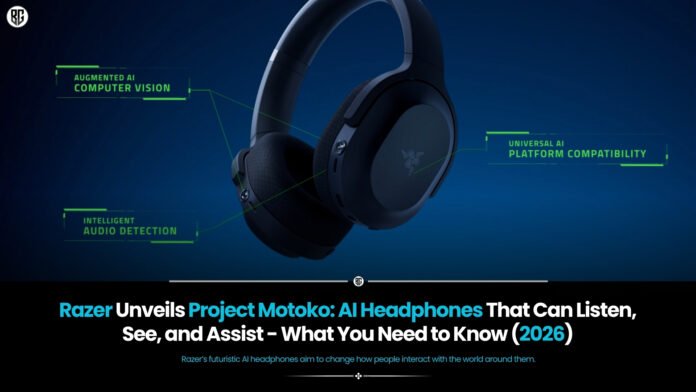
At CES 2026 Razer revealed Project Motoko – a concept pair of over-ear headphones that combine high-quality audio with onboard vision, environmental audio awareness and real-time AI assistance. Think of them as a discreet, headphone-shaped AI companion that can recognise objects and text, translate speech, summarize conversations, and help with on-the-fly tasks – all while you listen to music or work.
What is Project Motoko?
Project Motoko is Razer’s prototype “AI-native” headset. Rather than being just another pair of cans, Motoko packs:
- Dual first-person-view (FPV) cameras aligned roughly to the user’s eye line for depth, object and text recognition.
- A multi-microphone array that captures near-field voice and far-field environmental audio for contextual awareness.
- Onboard processing on a Snapdragon-class platform with connections to major AI services (OpenAI, Google Gemini, xAI’s Grok) for smarter replies and actions.
- Long battery life – Razer demonstrated up to ~36 hours in early tests.
Razer positions Motoko as an alternative to AI glasses: headphones are socially familiar, offer bigger batteries, better audio, and avoid the eyewear/vision prescription problem.
Key features (at a glance)
| Feature | What Razer demonstrated / promises |
|---|---|
| Cameras | Dual FPV cameras for text & object recognition and POV capture. |
| Audio | Far- and near-field mic array for voice, conversation capture, and environmental awareness. |
| AI integration | Works with multiple AI models (OpenAI, Gemini, Grok) for translation, summarisation, Q&A. |
| Processing | Qualcomm Snapdragon-class silicon onboard (details not final). |
| Battery | Demonstrated up to ~36 hours in testing – far longer than many AR glasses. |
| Use cases | Real-time translation, recipe help, workout tracking, quick summaries, POV capture for creators. |
How Motoko works – a simple, practical view
Motoko combines sight and sound to understand context. The cameras capture visual cues (a sign, a recipe, an item on a shelf), the microphones capture speech and ambient sounds, and the onboard chip either processes that locally or sends compressed context to your phone/cloud AI models to get answers. The result: the headset can tell you what an unfamiliar label says, translate a spoken sentence in real time, or summarise the gist of a short conversation.
Razer demoed translation and object ID live at CES, and emphasised that some tasks will be processed locally while others may use cloud models depending on complexity and connectivity.
Real-world use cases
- Commuting & travel: Translate signage and short conversations while keeping your hands free.
- Students & researchers: Quickly summarise long email threads or lecture clips recorded via POV capture.
- Creators & streamers: Capture point-of-view footage and get instant contextual captions or topic summaries for clips.
- Kitchen & daily life: Ask “what can I make with these ingredients?” and get step-by-step voice guidance while you cook.
- Work & productivity: Receive meeting highlights and action items from short recorded exchanges (with proper consent).
Pros and cons – the practical tradeoffs
Pros
- Familiar form factor: many people already use headphones daily, so adoption friction is lower than with smart glasses.
- Longer battery life than most AR glasses – suitable for all-day use.
- Useful mix of on-device processing and cloud AI to balance privacy, latency and capability.
Cons / concerns
- Privacy: Cameras and “always-listening” mics raise clear privacy questions – both about recording others and the data Razer might collect. Razer shows an indicator LED in demos, but public comfort will vary.
- Concept stage: Motoko is a concept; Razer hasn’t finalized pricing, regulatory approvals, or a firm launch date – it may never ship.
- Reliance on cloud AI: Some features need internet and may depend on subscriptions, latency and regional availability of services.
Privacy, safety and the rules you should know
Razer says Motoko won’t be a “secret recorder” – demos included a visible recording indicator and Razer framed the device around consented, helpful interactions. Still, headphones with cameras and continuous audio capture will draw scrutiny and may face stricter rules in some countries about recording in public or private spaces. If you use a device like Motoko, respect local laws (laws about audio/video capture, workplace consent, etc.) and check device privacy settings.
Availability & price expectations
Razer positioned Project Motoko as a concept at CES 2026 and indicated plans to push the product toward a 2026 release window at a “slight premium” above high-end headphones. Official price and exact ship dates were not announced – expect Razer to clarify availability and pricing later in the year, and also expect an enterprise/early-adopter focus initially.
Project Motoko is one of those CES concepts that feels sensible: headphones are widely used, comfortable, and already part of many people’s daily routine. If Razer can ship a device that balances on-device privacy, powerful AI features, and robust battery life – without being creepy – Motoko could be a genuinely useful companion for travellers, creators, and busy professionals. For India, where multilingual support and hands-free help matter, Motoko’s promise is especially appealing – but we’ll reserve judgement until Razer shares pricing, local language support and real-world reviews.
FAQ
Is Motoko shipping now?
No – it was shown as a concept at CES 2026. Razer says it aims to release in 2026 but hasn’t given exact dates.
Does it record conversations and video all the time?
Razer’s demos show selective capture and an indicator light; the company stresses user control – but real-world usage will depend on settings and app behaviour.
Which AI models does Motoko use?
Razer demonstrated compatibility with multiple providers (OpenAI, Google Gemini, xAI’s Grok) so users may choose services for translations, summarisation and more.
How long is the battery?
Early demonstrations cited up to ~36 hours in specific scenarios – a strong figure compared with many smart glasses.
Will it be useful in India?
Yes – features like translation, text recognition, recipe help and hands-free assistance have direct value for students, creators and professionals in India. Availability and model language support will determine how well it works locally.
Found this article interesting? Follow BG on Facebook, Twitter and Instagram to read more exclusive content we post.