
For years, online translation has been almost synonymous with Google Translate. It’s fast, free, and everywhere. But now, OpenAI is stepping into the ring with a new AI-powered translation feature built into ChatGPT and it’s taking a very different approach.
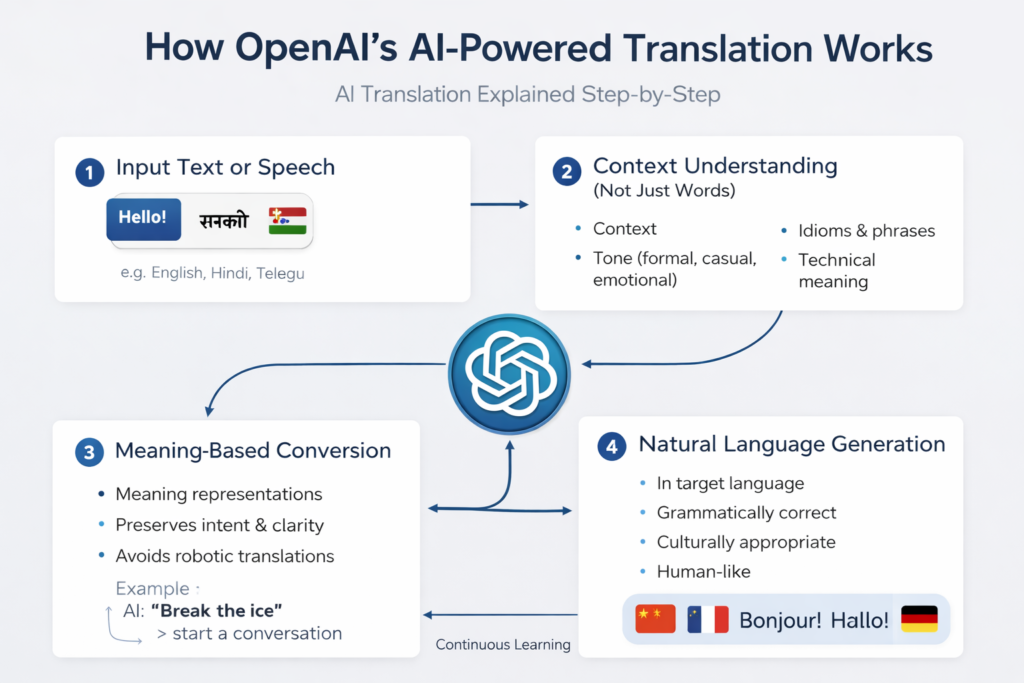
Instead of just converting words from one language to another, OpenAI’s translation tool focuses on meaning, tone, and context. In simple terms, it tries to translate the message, not just the sentence.
What’s New About OpenAI’s Translation Feature?
Unlike traditional translators, ChatGPT’s new translation mode lets users go beyond basic “A to B” language conversion.
Here’s what makes it stand out:
- Context-aware translations
You can ask for translations that are formal, casual, professional, or even academic. The AI adjusts the language accordingly. - Meaning-first approach
Idioms, slang, and cultural phrases are handled more naturally, instead of being translated word-by-word. - Multi-language conversations
Users can translate long conversations, documents, or back-and-forth chats without resetting the language every time. - Editable and explainable output
You can ask why a phrase was translated a certain way, or request alternatives something traditional translators don’t offer.
In short, it feels less like a tool and more like a bilingual assistant.
How This Challenges Google Translate
Google Translate is excellent for speed and scale. It supports hundreds of languages and works instantly. But OpenAI is aiming at a different pain point: accuracy with nuance.
| Feature | Google Translate | OpenAI Translation |
|---|---|---|
| Speed | Extremely fast | Fast, but conversational |
| Tone control | Limited | High (formal, casual, etc.) |
| Context handling | Moderate | Strong |
| Explanations | ❌ | ✅ |
| Long-form content | Basic | Very strong |
For quick one-line translations, Google Translate still wins. But for emails, scripts, subtitles, legal text, or creative writing, OpenAI’s approach can feel more human.
Why This Matters (Especially for Creators & Professionals)
This isn’t just about competition it’s about how people communicate globally.
- Content creators can translate scripts, captions, and blogs while preserving tone.
- Students can understand foreign-language material with explanations.
- Businesses can localise emails and documents more naturally.
- Developers & researchers can work with multilingual content more efficiently.
For Indian users especially where English, Hindi, and regional languages often mix context-aware translation can be a big advantage.
A Sign of a Bigger Shift in AI Tools
OpenAI’s move signals a broader trend: AI tools are becoming assistants, not utilities.
Translation is no longer just:
“Convert this sentence.”
It’s becoming:
“Help me say this properly in another language.”
That shift could eventually change how people learn languages, communicate internationally, and even consume global content.
Is Google Translate in Trouble?
Not immediately.
Google Translate is deeply embedded across Android, Chrome, and Search. But OpenAI’s translation feature is clearly aimed at power users people who care about tone, clarity, and meaning.
Think of it this way:
- Google Translate is a calculator
- OpenAI translation is a language expert sitting next to you
Both have their place.
OpenAI entering the translation space doesn’t kill Google Translate but it raises the bar.
By focusing on context, intent, and human expression, OpenAI is redefining what “translation” can mean in the AI era. For anyone who works across languages not just words this is a genuinely exciting step forward.
And chances are, this is only the beginning
FAQ’s
What is OpenAI’s new AI-powered translation feature?
OpenAI’s new AI-powered translation feature uses advanced large language models to deliver more natural, context-aware translations compared to traditional tools. It focuses on understanding tone, intent, and cultural nuances rather than just word-for-word translation.
How is OpenAI’s translation different from Google Translate?
Unlike Google Translate, OpenAI’s translation feature emphasizes contextual understanding, conversational accuracy, and domain-specific language. It performs better with complex sentences, idioms, and professional or creative content.
Which languages are supported by OpenAI’s translation tool?
OpenAI supports dozens of global languages, including major Indian and regional languages. Support continues to expand as the model is trained on more multilingual datasets.
Is OpenAI’s translation tool free to use?
Availability depends on the platform and plan. Some translation features may be available for free, while advanced or API-based usage could require a paid subscription.
Can businesses use OpenAI’s translation feature?
Yes. Businesses can integrate OpenAI’s translation capabilities through APIs for customer support, global content creation, localization, and real-time multilingual communication.
Found this article interesting? Follow BG on Facebook, Twitter and Instagram to read more exclusive content we post.